An entrepreneur willing to contribute to the healthcare sector while running a profitable business could look into starting a medical device business in India. This is basically an industry of essential tools for hospitals, clinics, and patients for purposes of diagnosis, treatment, and recovery. Indian medical device industry provides everything, including surgical instruments and sophisticated AI-embedded devices. Starting a medical device business in India requires proper planning, CDSCO licensing, and strict regulatory compliance, along with astute execution.
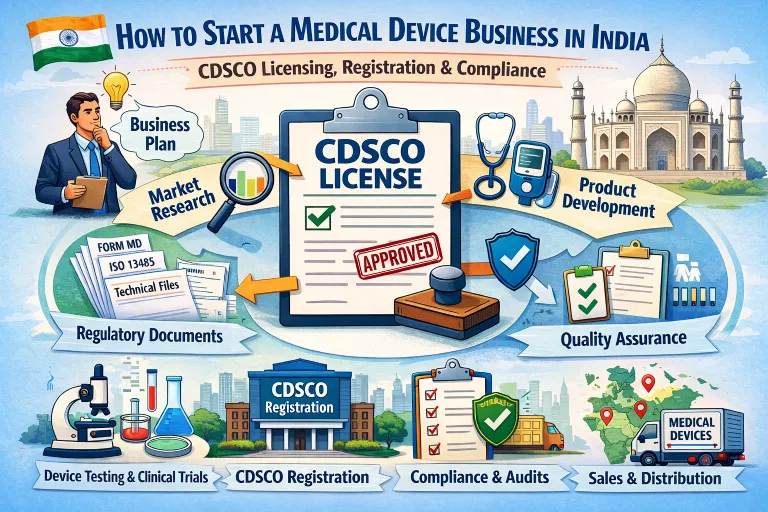
This blog will discuss the types of opportunities, the licensing process, key medical device regulatory compliance in India, and practical steps in establishing a sustainable business in this ever-growing field.
Table of Contents
Scope of the Medical Device Business in India
The Indian healthcare industry is booming, and so is the need for good-quality devices. Increasing population, lifestyle diseases, and increased awareness have contributed to fueling the demand for advanced healthcare equipment. It is thus not merely a business of manufacturing or distributing devices but of meeting genuine and urgent needs.
Whether producing, distributing, or renting devices, you can break into markets such as diagnostic equipment, surgical devices, hospital equipment, or home healthcare devices. They each have their own potential based on your experience and investment.
Popular Medical Device Business Models in India
Various business models that business owners can go for:
| Business Model | Examples |
| Diagnostic Equipment | MRI, CT, X-ray, and ultrasound machines are used for early detection |
| Therapeutic Devices | Ventilators, oxygen concentrators, dialysis machines |
| Surgical Tools | Scalpels, advanced surgical kits, robotic-assisted systems |
| Home Healthcare Devices | Blood pressure monitors, glucometers, mobility aids |
| Wearables | Smartwatches, fitness trackers, and preventive healthcare gadgets |
| Hospital Infrastructure | ICU beds, patient trolleys, and operating tables |
| Consumables | Masks, gloves, syringes, disposables |
| AI & Software Solutions | Telemedicine apps, diagnostic AI, and healthcare data platforms |
| Medical Equipment Rental | Beds, oxygen machines, and short-term rental devices for patients |
These medical device business opportunities have good market demand, and therefore, startups as well as established companies are able to expand.
Medical Device License in India (CDSCO Approval Process)
Prior to commencing operations, obtaining CDSCO medical device approval is required. The Central Drugs Standard Control Organization (CDSCO) issues a medical device license in India. Based on the device risk class (Class A to D), you will need various kinds of medical device manufacturing or import license.
- Class A & B devices: State Licensing Authority approval.
- Class C & D devices: CDSCO approval at the central level.
This guarantees that available products in the market are safe, effective, and trustworthy.
Medical Device Registration Process in India
In order to distribute or sell lawfully, companies must undergo the medical device registration process. The procedures include:
- Company registration under the Companies Act or as an LLP.
- Submission of licenses online in CDSCO medical device registration forms (MD-40 & MD-41).
- Furnishing information on manufacturing facilities, quality levels, and safety measures.
- Furnishing test reports of products and certificates.
- Subject to the sanction of CDSCO or the State Licensing Authority.
For small industry players, there is software such as MD-41 Registration Online to facilitate it. Notified device companies also need to undergo NSNM medical device registration to be compliant.
Medical Device Compliance Requirements in India
Being compliant is an important part of running this business. Each device must comply with national and international standards. Some of the main rules are:
- Medical Device Rules, 2017: Regime for testing, safety, and licensing.
- Good Manufacturing Practices (GMP): Ensures the best-quality products.
- ISO 13485 Certification: Encourages trust among hospitals and customers.
- Post-Market Surveillance: Continuous monitoring of device performance.
Compliance with these standards not only avoids legal issues but also strengthens brand reputation. That is why medical device business compliance India stands as one of the biggest factors for entrepreneurs.
GST and Tax Registration for Medical Device Business in India
For hassle-free operations, businesses also need to take care of taxation.
- Importing, manufacturing, or trading equipment requires GST registration online.
- Imports attract customs duties based on the type of product.
- Tax relief is provided to exporters under schemes such as RoDTEP.
Maintaining current accounts and availing tax credits saves money in the long term.
Challenges in Starting a Medical Device Business in India
While the high growth prospects exist, entrepreneurs need to be prepared to confront challenges like:
- High Investment Requirements: It is expensive to produce, test, and develop.
- Long Approval Period: Approval takes months in the form of licensing.
- Price Control: Certain items are controlled by government regulatory bodies by imposing a limit on the profit margin of these products, so they become inexpensive.
- Skilled Workforce: The industry lacks skilled engineers and regulatory personnel.
- Import Dependence: Most devices are sourced overseas, posing supply risks.
These must be overcome through planning, good supplier relations, and continuous funding.
Step-by-Step Guide to Start a Medical Device Business in India
If you are thinking of going into this business, the following are some easy steps to follow:
- Begin with detailed research and select your area of product.
- Start with business registration and application for licenses.
- Setting up quality systems and putting skilled staff on.
- Collaboration with distributors, hospitals, and clinics.
- Marketing of your products basically on trade shows and web platforms.
- Offer after-sales service, training, and support to develop trust.
By following these steps, you can lay a solid foundation and grow in the future.
Final Thoughts
For those willing to invest in innovation, quality, and compliance, the Indian medical devices sector offers enormous opportunities. In spite of challenges, the increasing demand for high-tech healthcare products guarantees long-term profitability to a well-developed medical device business under the law.
It is a balancing act to have a successful enterprise through fulfilling the needs of consumers without over-regulating in contravention of required licenses and updated standards. The medical device business in India is a profitable and future-ready opportunity when supported by proper licensing and compliance.