Cloud kitchens are transforming the Indian food sector, enabling entrepreneurs to prepare and deliver food via platforms such as Swiggy, Zomato, and Zepto Cafe. With no physical shop and fewer labour expenses, they prove to be a compelling choice for food entrepreneurs, but the key to success lies in smart planning.
Understanding the cloud kitchen registration process, compliance requirements, setup costs, securing all required licenses, adopting the right technology, and building effective pricing and marketing strategies are crucial to start a cloud kitchen. This guide shows how to start and expand a successful cloud kitchen business in India with complete legal compliance.
Table of Contents
What is a Cloud Kitchen: Ghost Kitchen vs. Virtual Kitchen Definition & Meaning in India
Cloud kitchen is also referred to as ghost kitchen, virtual kitchen, or dark kitchen. It is an online food business setup, which prepares food exclusively for online orders placed on food delivery apps like Zomato, Swiggy, Uber Eats, or in-house apps. These delivery-only kitchens avoid dine-in services and significantly reduce restaurant overhead expenses compared to traditional restaurants.
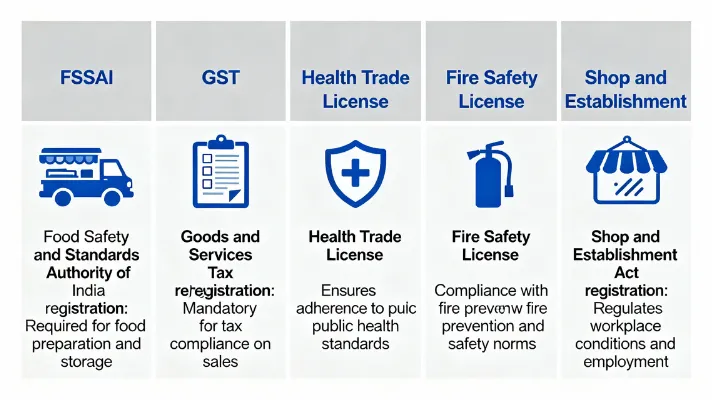
FSSAI License & All Legal Licenses Required for Cloud Kitchen in India: Complete Checklist
1. FSSAI License for Cloud Kitchen in India: Registration, Documents, Application & Renewal Process
The most essential and mandatory requirement for obtaining a legal cloud kitchen business in India is the FSSAI licence. It provides customers with the reassurance that food safety practices have been implemented. Each of the licenses will contain a unique registration number of 14 digits that is valid for one to five years, after which they must be renewed.
Documents Required
- Proof of identity and address
- Valid phone number and email address
- Food safety management declaration and affidavit
- Food category list and kitchen layout plan
- Water testing report from ISI-licensed facility
- NOC from partner or owner
- Medical certificates of employees
How to Apply
Applicants need to register on the FSSAI site, upload the cloud kitchen documents required, and fill out the form online. A hard copy of the filled form, together with supporting documents, should be sent to the Regional or State Authority within 15 days from online submission.
2. GST Registration for Cloud Kitchen in India: Documents Required & Step-by-Step Application Process
GST registration has been made compulsory for cloud kitchens since July 2017. GST makes tax management easy, makes business functions smooth, and facilitates easy vendor relationships for food businesses. One can submit a GST application online at the GST portal individually, as a partnership firm, or as a company.
Documents Required
- Photograph of the owner or partner
- Proof of property ownership or rent agreement, along with the electricity bill
- NOC in case of neither ownership nor rent of a property
- Bank documents, like a statement, a passbook, or a cancelled cheque
How to Apply
GST online registration can be enrolled on the GST portal (www.gst.gov.in) by providing the required documents. The entire process is online.
3. Health Trade License for Cloud Kitchen in India: Documents, Requirements & Application Process
This cloud kitchen license in India is issued by local municipal corporations to ensure public health protection and food safety standards. It confirms the hygiene, sanitation, and safety of food preparation operations at the cloud kitchen.
Documents Required
- Proof of ownership, rent agreement, or landlord NOC
- Rs. 100 indemnity bond
- Police verification letter
- Structural stability certificate from an engineer
- Power and water bills
- Water testing reports
- Employee medical fitness certificates
- Property tax evidence
- Lal Dora certificate (Delhi alone)
How to Apply
An online application can be made on the website of the municipal corporation or at the Citizens’ Service Bureau. Licenses will typically be issued within 60 days of application using the food license apply online option.
4. Fire Safety License for Cloud Kitchen in India: Why It's Required, Requirements & How to Apply
While it can be deferred initially, obtaining a fire and safety license is essential for complete cloud kitchen legal compliance with not just fire safety regulations and workplace safety standards but also local regulatory requirements.
Shop & Establishment Act Registration for Cloud Kitchen in India
You need to register under this Shop & Establishment Act within 30 days from when you start operating your cloud kitchen business. This mandatory registration applies to food trucks, cloud kitchens, and restaurants. The license is city-specific and issued by local labor departments.
Documents Required
- PAN card
- Identity and address proof
- Employee details
- Ownership or rental document
How to Apply
Applicants must submit the form and documents to local chief inspectors or other official authorities. The application should include the shop name, address, and ownership proof. Upon verification, registration certificates are issued by the authorities.
Cloud Kitchen Setup Cost in India: Complete Investment & Budget Breakdown (₹5-20 Lakhs)
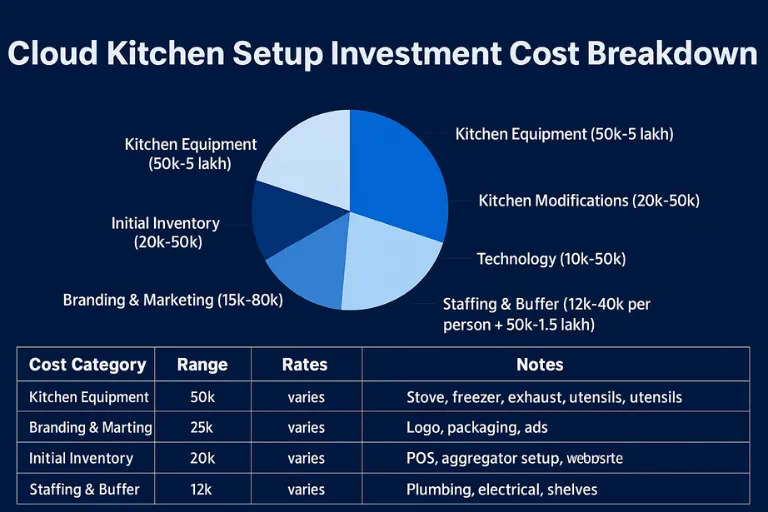
1. Kitchen Equipment and Appliances Cost
Initial investment for kitchen equipment and appliances for your cloud kitchen startup business varies from Rs. 50,000 to Rs. 5,00,000 or higher based on the kitchen size and equipment selection.
Essential expenditure includes commercial-grade burners, ovens, fryers, refrigerators, deep freezers, preparation equipment, cookware, shelves, exhaust systems, sinks, and dishwashing machines. Many entrepreneurs opt for second-hand or used kitchen equipment to reduce costs while maintaining food safety and hygiene standards.
2. Initial Inventory & Raw Materials
Budgeting between Rs. 20,000 and Rs. 50,000 covers raw materials, quality packaging, professional branding, and food-safe cleaning supplies. Quality packaging and attractive branding materials enhance your food delivery business appeal to customers.
3. Kitchen Modifications & Renovation Work
Kitchen modification expenses range from Rs. 20,000 to Rs. 50,000 for essential plumbing work, electrical wiring upgrades, food-safe surface improvements, and electricity or gas meter security deposits required by municipal authorities.
4. Technology Arrangement & Software Systems
Technology expenses range from Rs. 10,000 to Rs. 50,000 for billing machines, digital order management systems, Kitchen Display Systems (KDS), high-speed internet connectivity, security cameras, and website or mobile app development for online ordering.
5. Branding, Marketing & Digital Promotion
Invest Rs. 15,000 to Rs. 80,000 or more on professional logo design, food photography, digital marketing campaigns, social media advertising, influencer partnerships, and online promotions for the launch phase.
6. Staffing, Salaries & Emergency Buffer Fund
Essential staff salaries including head chef, kitchen helper, and packaging staff cost between Rs. 12,000 and Rs. 40,000 each per month. Having a reserve buffer fund of Rs. 50,000 to Rs. 1,50,000 helps cover unexpected operational costs and emergency expenses.
Cloud Kitchen License Renewal & Legal Compliance Requirements: Complete Compliance Checklist
1. Hygiene, Food Safety Standards & Sanitation Procedures
Complete compliance with FSSAI cleanliness standards, proper waste disposal procedures, and safe food handling methods is essential for ongoing operations. Regular compliance audits and inspections ensure your kitchen maintains food safety standards at all times.
2. Timely License Renewal & Deadline Management
FSSAI licenses are valid for one to five years depending on the license type. License renewal applications must be filed at least 30 days in advance through the official FoSCoS portal to avoid lapses. Delayed renewal may lead to excessive fines, operational disruptions, and business closure.
3. Staff Training, Medical Certification & Food Safety Certification
Properly certified food handlers enhance food safety and hygiene process efficiency. All food handlers must maintain valid medical fitness certificates, and key staff categories must possess FoSToC (Food Safety Training Certificate) certification for compliance with FSSAI regulations.
Cloud Kitchen Registration Process in India: 6-Step Timeline
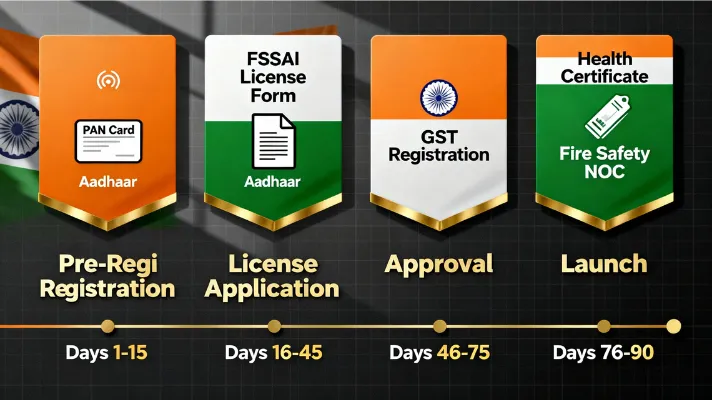
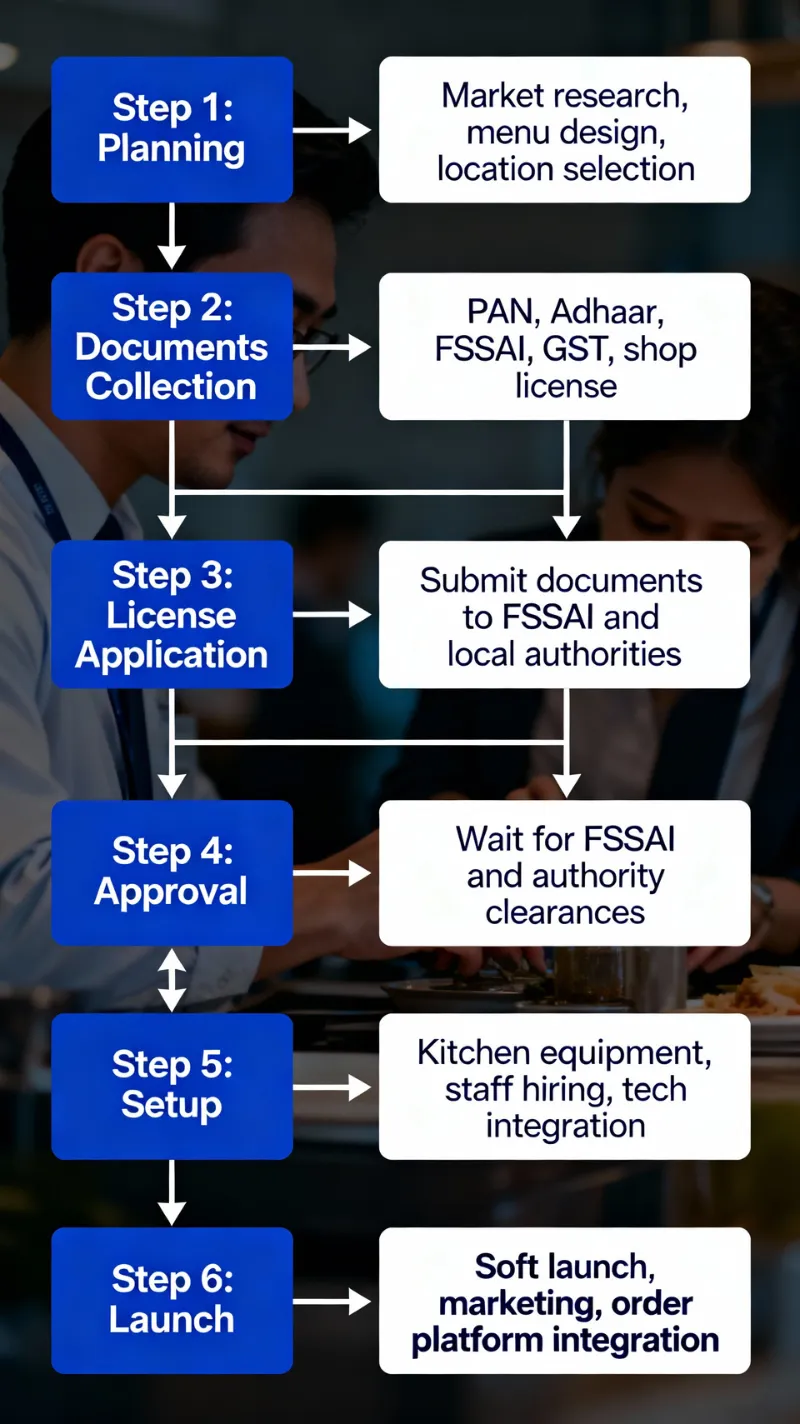
Starting a cloud kitchen involves sequential and parallel steps that take 60-90 days from planning to launch. Here's the complete step-by-step process:
Process Timeline Breakdown:
- Step 1 - Planning (7-14 days): Market research, menu design, location selection
- Step 2 - Documents Collection (5-7 days): PAN, Adhaar, FSSAI, GST, shop license documents
- Step 3 - License Application (Parallel): Submit documents to FSSAI and local authorities
- Step 4 - Approval (30-60 days): Wait for FSSAI and authority clearances
- Step 5 - Setup (10-15 days, Parallel): Kitchen equipment, staff hiring, tech integration
- Step 6 - Launch (Immediate): Soft launch, marketing, order platform integration
Total Expected Timeline: 60-90 days from start to operational launch
Penalties for Non-Compliance: Legal Consequences & Fines
Cloud kitchen operators must understand the legal penalties and financial consequences for failing to comply with food safety regulations and licensing requirements. Below are the major penalties for non-compliance:
- Operating without a license may result in fines up to Rs. 5 lakhs and imprisonment for six months.
- Serving substandard food can attract a fine of up to Rs. 3 lakhs.
- Misleading advertisements can cost up to Rs. 10 lakhs.
- Poor hygiene can result in further penalties.
- These fines show the need for strict cloud kitchen compliance with FSSAI regulations.
Conclusion: Start Your Successful Cloud Kitchen Business in India
Starting a cloud kitchen business in India presents tremendous growth opportunities for food entrepreneurs, but success requires achieving complete regulatory compliance, controlling startup costs, and ensuring high food safety standards. Proper cloud kitchen registration process execution, careful business planning, timely license renewals, and strict hygiene protocols establish strong customer confidence and long-term business sustainability. With proper planning and compliance management support, your cloud kitchen can remain competitive and future-proof.