Importing goods gives the chance of global markets, expanded product offerings and business growth. However, getting into international trade is not as simple as placing an order and waiting for the delivery. Apart from choosing the right supplier, businesses need to face the world of customs clearance for importing goods, along with licensing procedures and regulatory compliance to ensure a smooth flow of goods across borders.
Without proper planning and understanding of these requirements, even the most promising import venture can face costly delays or legal complications. That’s why we are here with this blog! We’ll be breaking down the procedure of how to comply with such customs and licensing requirements for your imports. Let’s dive in!
Table of Contents
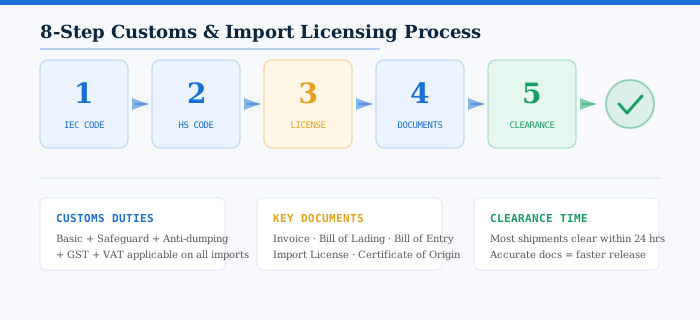
Steps to Comply with Customs & Licensing Requirements for Importing Goods
Here is detailed guidance on how you can comply with the customs clearance for importing goods and their licensing requirements:
1. Understand the Legal & Regulatory Framework
The first and foremost step before you begin anything is to clearly understand the legal and regulatory framework for importing goods in your country. When you have knowledge of how this compliance procedure works, you will know what actions need to be taken and what is lacking to check all the lists of your import documentation and compliance.
Also, you need to be aware that the laws are different for each product. Therefore, you need to know your product-specific import licensing requirements in India. This saves your time by clearly planning your work for customs and licensing compliance.
2. Obtain an Importer-Exporter Code (IEC)
The next step is to apply for an IEC code for importing goods. IEC refers to Importer-Exporter Code, which is a 10-digit number for Indian businesses involved in importing and exporting goods. This has so much importance related to customs compliance for importers and exporters.
You can apply for it through the IEC online registration portal by providing the details of your PAN card, address proof and bank details.
3. Classify Your Goods
Once you get your IEC code, you need to classify the category of your product. For that, you need to get either the HS (Harmonized System) code or the ITC‑HS code. The ITC‑HS code is applicable in India, whereas HS is a global classification code. The HS is a six-digit code and ITC-HS is an eight-digit code.
These codes will check if your products are freely importable and what compliance your goods will require for imports. You can also check the taxes and duties for your products with the customs tariff and duty structure of HS and ITC-HS.
4. Get Your License
Now, you can apply and get all the licenses needed to import your products. You can check and do it by visiting the official website of the Directorate General of Foreign Trade. This can be done easily if you already have your IEC and HS code.
5. Documentation
You need to prepare proper import documentation. Each detail needs to be accurate and complete. Required documents are:
- Commercial Invoice
- Bill of Lading or Airway Bill
- Import License
- Certificate of Origin
- Bill of Entry
- Certificate of Insurance
Be careful while preparing this documentation because a single error or mismatch of details can cause delays with your import approval.
6. Customs Valuation, Duties and Taxes
Here, with your HS classification, officials will evaluate your imported products as per customs. They will also assess your import duties like safeguard duty, anti-dumping duty and more. You need to pay for the necessary duties and the applicable taxes.
Since imports have Goods and Services Tax and Value Added Tax, you also need to pay them also.
7. Undergo Customs Examination and Inspection
When you submit your import declaration through the Bill of Entry, you will need to undergo customs inspection and product examination. Officials will physically inspect your goods and check if the details match the documents provided.
When everything is clear, your goods will be approved for their import release with a release order from the customs officials. This order is called an “Out of Charge” order. But make sure that your taxes and duties are paid to carry out your product release.
8. Maintaining Records Post-import
If you think that your job with customs, compliance and regulations is done, then you are wrong. Because you need to maintain your records for compliance in order to avoid any issues later on.
Always have accurate records and documents of all your import transactions, invoices, licensing and certificates. You also need to stay updated on the new rules and customs. Regulations, tariffs, trade agreements and licensing policies tend to change over time. So, have your import requirements updated to the new policies.
Example of Cosmetics Import Registration
Now, let’s understand the whole procedure with an example of Cosmetics Import Registration. Let’s consider that you want to import skincare products from other countries into India.
For that, you need to register with the official portal. You can provide your product certificate, ingredient list and labels. You also need to pay the taxes and any other applicable fees. Make sure that your labels have your product name, its expiry date, batch number and usage details in English language.
Wrapping up
Importing goods is a large but valuable process. You need a clear plan, correct details with proofs and compliance with licenses. From the initial step to customs clearance for importing goods, every step needs to be handled properly to avoid any mistakes. When every step is done correctly, you can have a smooth importing experience.