BIS vs WPC ETA Certification in India: Complete Guide & Key Differences

In the current business and logistics landscape, legal compliance certifications are essential for product launches, mainly in India. This is even more important for electrical, wireless, or industrial equipment.

Recently, two certificates called WPC and BIS certifications have gained importance. Each is required for dealing with distinct product types. However, individuals either miss the distinct regulatory roles that each must play or confuse the two.

So, what distinguishes BIS vs WPC certification? In simple terms, it helps you quickly determine the certification requirements for your product and why they exist. If you are still unclear, this complete guide compares the two for you. Continue reading!

BIS VS WPC Certification?

Understanding The Basics: What is BIS Certification in India?

The BIS certification in India demands that products that are manufactured, imported, or sold have undergone testing in India and meet established safety and performance criteria. The products can be anything like toys, cement, electronics, or kitchenware.

Without completing the BIS certification process, manufacturers and importers risk delays, regulatory penalties, and even market bans.

SCHEDULE_CALL_BACK_CARD

BIS Certification Can Be of Two Types: Mandatory vs Voluntary

Mandatory BIS Certification: For goods covered by the Compulsory Registration Scheme or CRS.

Voluntary BIS Certification: This is for brands that want to vouch for their quality promises when their product is not covered by CRS.

The BIS essentially ensures that the product meets quality and safety standards for use in India.

What is WPC ETA Certification in India and What Does It Cover?

The Indian Communications Ministry's Wireless Planning and Coordination Wing is also called WPC. The WPC ETA approval process is largely documentation-driven and requires RF test reports, product datasheets, and formal submissions to the Wireless Planning & Coordination Wing.

In order to guarantee that the item is not interfering with any other communication channel, your product must obtain a WPC Certification if it employs any kind of wireless technology, such as Bluetooth, Wi-Fi, RF modules, etc.

The Major Wireless Products That Need WPC Certification Are:

  • Mobile phones
  • Wireless headphones
  • Routers
  • Smartwatches
  • IoT Devices
  • RFID Equipment

Through this streamlined WPC ETA approval process, wireless-enabled products get legal clearance to operate on India's permitted frequency bands.

Key Differences Between WPC and BIS Certification

Despite being required for some items, both certifications have completely distinct scopes and certification processes.

If you compare BIS vs WPC certification, know that BIS certification is focused on safety and quality, and WPC handles frequency compliance. This means that even if a wireless product has a great design and is safe (according to BIS), WPC must approve it for the spectrum it uses.

For instance, BIS certification requires smart TVs to meet safety and quality standards. It goes without saying that any Bluetooth or Wi-Fi modules installed on them must receive WPC approval. As a result of new technologies, many contemporary devices need dual certification from both BIS and WPC before they can be sold or used legally in India.

Another significant distinction is that WPC often only needs documentation, such as RF test reports from international labs, in certain situations.

The BIS certification process involves mandatory in-country testing of product samples in BIS-approved labs, ensuring compliance with quality and safety standards before they reach Indian consumers.

Which Products Require Mandatory BIS Certification?

SCHEDULE_CALL_BACK_CARD

Let's understand this with greater clarity. Among the products needing mandatory BIS certification are:

  • Mobile phones and tablets
  • LED lights and bulbs
  • Laptop and computer peripherals
  • Power banks
  • Air conditioners and refrigerators
  • Washing machines
  • Microwave ovens
  • Pressure cookers and helmets
  • Electric irons, electric kettles, and many more

Therefore, mandatory BIS registration for electronics must be obtained before any items specified under the CRS are sold to the Indian market, regardless of whether they are manufactured or imported.

Which Wireless Products Require WPC Approval?

All wireless products involving the sending or receiving of radio signals must obtain a WPC license online application. This includes:

  • Wireless Speakers
  • Bluetooth Devices
  • Wi-Fi Routers
  • Smart watches
  • GPS Trackers
  • Cordless Phones
  • RFID Readers
  • Wireless Medical Devices
  • Devices with RF Modules

According to regulatory requirements, WPC approval for wireless products must be obtained for every device that has wireless capabilities, including Bluetooth and Wi-Fi modules.

Do You Need Both BIS and WPC Certification?

Nowadays, very few products include only wireless components or are entirely electronic. A smartphone needs to obtain BIS registration for electronics for the phone, battery, and adapter. But it also requires separate WPC approval for mobile frequency bands, Bluetooth, and Wi-Fi.

In summary, a single product may require multiple certifications, depending on its features and parts. Experts who specialize in BIS and WPC certification requirements are a good choice as they understand which certifications your products need. They can manage all the compliance documentation and permissions without issues.

Consequences of Non-Compliance

  • Customs are preventing uncertified gadgets from being imported
  • Indian retail sellers are not listing or selling your gadgets
  • Legal actions or fines imposed by regulatory agencies
  • Product recalls and losses

So, it is always critical to invest time and effort in securing the appropriate BIS and WPC certifications before product sales to the Indian market.

BIS vs WPC Certification: Process & Documentation Comparison

BIS Certification Process Steps Include:

  • Testing device samples in an Indian lab recognized by BIS
  • The submission of papers such as test report files, factory licenses, and the KYC of the business
  • Factory inspection
  • Procuring the last stage BIS registration

WPC Certification Process Steps Include:

  • RF Test report papers of the wireless module (normally from NABL-approved or international labs)
  • Product datasheet and technical papers
  • Authorisation papers and undertakings
  • ETA submission to the WPC

As a result, BIS certification in India normally takes more time when there is a full certification setup. But WPC approval for wireless products can be quicker if all the required documentation is in place.

SCHEDULE_CALL_BACK_CARD

Final Thoughts: BIS vs WPC Certification for Market Success

Lastly, if any manufacturer or importer wants to succeed in the Indian market, they must understand the distinct differences between BIS and WPC certification requirements. Both are equally important for regulatory compliance, and neglecting either could postpone market access or result in legal penalties. By obtaining the required BIS and WPC certifications proactively, you ensure smooth market entry and trouble-free business operations.


FAQs

Is BIS Certification Mandatory for All Electronic Products in India?

No. BIS (Bureau of Indian Standards) certification in India is mandatory only for specific electronic products and appliances listed under the BIS Compulsory Registration Scheme (CRS). Not all electronic products require BIS certification for sale in the Indian market. Products not included on the official mandatory BIS certification list do not need BIS certification for legal import or sale. It's important to check the CRS list to determine if your product requires mandatory certification.

When is WPC ETA Certification Required for Wireless Products?

WPC ETA (Equipment Type Approval) certification is mandatory for all wireless products that transmit or receive radio signals. This includes devices using Bluetooth, Wi-Fi, or other RF (Radio Frequency) communication technologies. Additionally, any product operating on permitted frequency bands in India or de-licensed spectrum must obtain WPC ETA approval. Examples include smartphones, routers, smartwatches, Bluetooth speakers, and other wireless-enabled devices.

Do You Need Both BIS and WPC Certification for the Same Product?

Yes, absolutely. Any product that contains wireless technology such as Bluetooth, Wi-Fi, or RF modules must obtain both BIS and WPC certification for legal import and sale in the Indian market. Common examples include smartphones, tablets, laptops, smart TVs, wireless earbuds, smartwatches, and IoT devices. The product requires BIS certification for safety and quality compliance, and separate WPC ETA approval for wireless frequency spectrum compliance. Obtaining both certifications ensures full regulatory compliance and avoids market access issues.

What is the Difference Between BIS Certification and WPC ETA Approval?

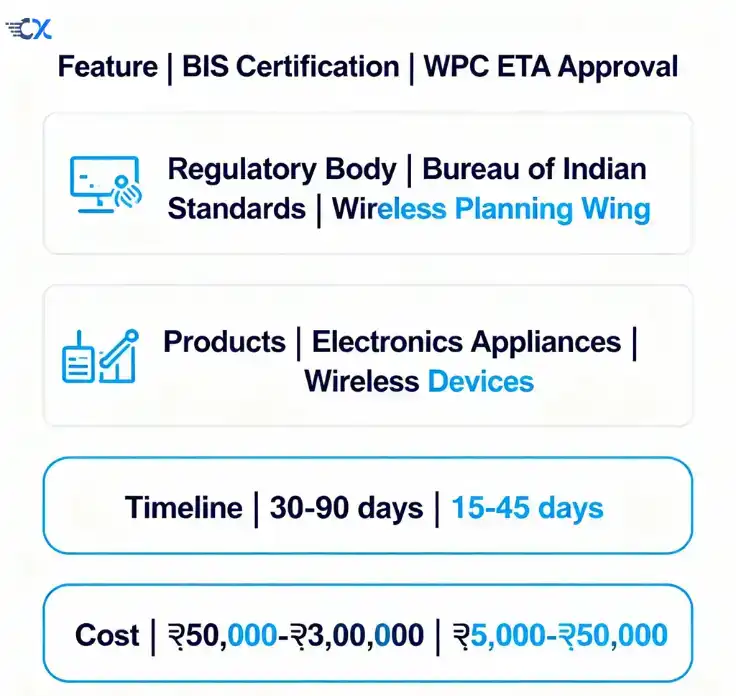
BIS (Bureau of Indian Standards) certification in India ensures product safety and quality compliance according to Indian Standards (IS codes). It verifies that products meet safety requirements and quality benchmarks before reaching Indian consumers. In contrast, WPC ETA (Equipment Type Approval) focuses on wireless frequency spectrum compliance and radio frequency (RF) regulation in India. WPC approval ensures that wireless devices operate only on India's permitted frequency bands without causing interference to national communication networks. In summary: BIS = Safety & Quality | WPC ETA = Frequency & Spectrum Compliance.

What is the BIS Certification Timeline and Cost for Electronics in India?

BIS certification timeline and cost vary based on product complexity and category:

  • Timeline: 30-90 days on average, depending on product type, factory location, and testing requirements.
  • Cost Range: ₹50,000 to ₹3,00,000+ depending on product category and complexity, number of product samples tested, need for factory inspection, and testing lab charges.

Factors Affecting Timeline:

  • Mandatory in-country testing in BIS-approved laboratories
  • Factory inspection by BIS officials
  • Submission of complete documentation
  • Any corrections needed in test reports

Cost Includes: Laboratory testing fees, BIS registration fees, factory inspection charges (if applicable), and documentation and certification fees.

Tip: Starting the BIS certification process early helps avoid delays in market entry to the Indian market.

What is the WPC ETA Certification Timeline and Cost for Wireless Products?

WPC ETA certification timeline and cost are typically lower than BIS certification:

  • Timeline: 15-45 days on average, depending on documentation completeness.
  • Cost Range: ₹5,000 to ₹50,000 depending on product complexity, number of wireless modules, and laboratory testing location.

Factors Affecting Timeline:

  • RF (Radio Frequency) test reports from NABL-approved or international labs
  • Completeness of product datasheets
  • Technical specifications and frequency band details
  • Quality of submitted documentation

Cost Includes: RF testing costs (if not already done), WPC application and processing fees, documentation preparation (if outsourced), and ETA submission and approval fees.

Advantage: WPC certification is primarily documentation-driven, making it faster than BIS certification when all required documents are ready.

Which Products Are on the BIS Mandatory Certification List (CRS)?

Products requiring mandatory BIS certification under the Compulsory Registration Scheme (CRS) include:

Electronics & Appliances:

  • Mobile phones, tablets, and smartphones
  • Power banks and portable chargers
  • Laptop and computer peripherals
  • LED bulbs and lights
  • Air conditioners
  • Refrigerators
  • Washing machines
  • Microwave ovens
  • Water purifiers

Safety Products:

  • Helmets (motorcycle, sports)
  • Electric irons and kettles
  • Pressure cookers

Important Note: The BIS CRS list is regularly updated based on product categories and regulatory requirements. Always check the official BIS website or consult with certification experts to confirm if your specific product requires mandatory BIS registration in India.

Which Wireless Devices Need WPC ETA Certification?

All wireless devices that use radio frequency (RF) communication require WPC ETA certification. Examples include:

Communication Devices:

  • Smartphones and mobile phones
  • Cordless phones and wireless handsets
  • Walkie-talkies and two-way radios

Computing & Networking:

  • Wi-Fi routers and mesh networks
  • Laptops with Wi-Fi/Bluetooth modules
  • Portable Wi-Fi hotspots
  • Network modems

Consumer Electronics:

  • Wireless speakers and Bluetooth speakers
  • Wireless headphones and earbuds
  • Smartwatches with Bluetooth/Wi-Fi
  • Fitness trackers with wireless connectivity
  • Smart TVs with wireless modules

IoT & Industrial Devices:

  • GPS trackers and navigation devices
  • RFID readers and tags
  • IoT sensors and connected devices
  • Wireless medical devices
  • Industrial wireless systems

Key Point: Any device with Bluetooth, Wi-Fi, RF, or cellular connectivity requires mandatory WPC approval for legal operation in India.

What are the Consequences of Selling Products Without BIS or WPC Certification in India?

Non-compliance with BIS and WPC certification requirements in India can result in serious business consequences:

Legal & Regulatory Penalties:

  • Product seizure at customs during import
  • Fines and penalties imposed by regulatory authorities
  • Legal action and prosecution under Indian standards laws
  • Temporary or permanent ban on product sales in India

Business Impact:

  • Market access restrictions - Products blocked from entering Indian market
  • Retailer refusal - Major retailers won't stock uncertified products
  • E-commerce platform delisting - Online marketplaces remove products
  • Reputation damage - Loss of customer trust and brand value
  • Product recalls - Costly recalls if non-compliant products reach market
  • Financial losses from destroyed inventory and delayed market entry

Operational Delays:

  • Port holds and customs delays costing time and money
  • Extended market entry timelines while obtaining certifications
  • Rework and re-testing costs if initial shipments are rejected

Prevention: Always obtain mandatory BIS and WPC certifications proactively before product launch to ensure smooth market entry and regulatory compliance.

How Do I Know if My Product Needs BIS Certification or WPC ETA Approval or Both?

Use this simple decision tree to identify your product's certification requirements:

Step 1: Is your product an electronic device or appliance?

  • YES → Check if it's on the BIS Compulsory Registration Scheme (CRS) list
  • NO → Skip to Step 2

Step 2: Does your product have wireless capabilities?

(Bluetooth, Wi-Fi, RF modules, cellular, GPS, RFID, or any radio frequency transmission)

  • YES → Product requires mandatory WPC ETA certification
  • NO → Skip to Step 3

Step 3: Determine final requirement:

  • Electronic + No wireless → Needs BIS certification only (if on CRS list)
  • Wireless + Not listed as electronic → Needs WPC ETA certification only
  • Electronic + Wireless → Needs BOTH BIS AND WPC certification
  • Neither electronic nor wireless → May not need either certification

Quick Examples:

Product BIS WPC Both
Smartphone ✓ YES
Smart TV ✓ YES
Wireless Router WPC only
Power Bank BIS only
Bluetooth Speaker WPC only
Smart Watch ✓ YES
Microwave BIS only

Expert Help: If you're unsure about your product's specific certification needs, consult with BIS and WPC certification specialists who can review your product specifications and provide accurate guidance.

Can I Use Foreign Laboratory Test Reports for BIS and WPC Certification in India?

It depends on the certification type:

For BIS Certification:

NO - BIS certification requires mandatory in-country testing. Test reports must come from BIS-recognized laboratories located in India. Foreign laboratory test reports are NOT accepted for BIS certification as the process requires:

  • Testing in India-based BIS-approved labs
  • Factory inspection by BIS officials in India
  • Compliance verification with Indian Standards

For WPC ETA Certification:

YES - WPC ETA approval accepts RF test reports from:

  • NABL-accredited laboratories (National Accreditation Board for Testing and Calibration Laboratories)
  • Internationally-recognized laboratories with equivalent certifications
  • Foreign testing facilities that meet international RF testing standards

This makes WPC ETA certification faster and more flexible than BIS certification.

Important Note: Always verify that your testing laboratory's credentials are recognized by BIS or WPC authorities before submitting reports to avoid rejection and delays.

How Long is BIS and WPC Certification Valid? Do I Need Renewal?

Validity periods differ for each certification:

BIS Certification Validity:

  • Validity Period: 3 years from the date of certification
  • Renewal Required: YES - BIS certification must be renewed every 3 years
  • Renewal Process: Similar to initial certification but typically faster if products haven't changed
  • During Validity: Annual surveillance inspections may be required by BIS

WPC ETA Certification Validity:

  • Validity Period: Indefinite (No expiration date)
  • Renewal Required: NO - Once approved, WPC ETA remains valid
  • Conditions: Remains valid as long as product specifications and frequency bands remain unchanged
  • Changes Needed: If product specifications or wireless modules change, re-certification may be required

Key Differences:

Aspect BIS WPC ETA
Validity 3 years Indefinite
Renewal Required Not required
Surveillance Annual inspections Not applicable
Re-certification Required after 3 years Only if product changes

Planning Tip: Start BIS renewal process 2-3 months before expiry to avoid market access interruptions. Maintain WPC ETA documentation to prove compliance if product specifications are reviewed.

Chat Us
Chat With Us